We weren't losing money because we had no recipes, no scales, or no understanding of food cost. We were losing money because we had no reliable way to connect what we bought, what we had, what we sold, and what we actually used.
After implementing a restaurant inventory and price-tracking system at our restaurant, we discovered that we were using roughly 30% more pepperoni than our expected recipe usage.
Over a full year, that one discrepancy added up to one of the largest avoidable costs in the kitchen.
And pepperoni wasn't the only problem.
Some meats were being portioned 40–50% above recipe targets, while prices on less frequently purchased products had quietly increased 10–18% without us noticing.
The biggest lesson wasn't that employees needed to be watched more closely.
It was that you can't manage restaurant food cost accurately if the information needed to manage it is scattered across shelves, invoices, receipts, memory, and spreadsheets.
The problem: we weren't really doing inventory
Before building the system, our ordering process was very common for an independent restaurant.
Before a delivery day, we would walk around the restaurant and look at what we had.
- How much cheese is left?
- How many cases of pepperoni?
- Do we have enough wings?
- How full is the freezer?
- How much room do we have for another delivery?
Then we would decide what to order based largely on experience, intuition, and what looked low.
We receive deliveries multiple times per week, which meant someone was effectively walking around and counting or visually checking product about four times every week just to prepare orders.
That process could tell us what we needed to buy that day.
It could not tell us whether we were using too much of something, whether a vendor price had been creeping upward, or whether the amount we were buying actually made sense relative to sales.
We had tried to track this manually before
The issue wasn't that we had never thought about inventory.
We had tried to track it.
The problem was that the process depended on too much manual work.
To properly track food cost by hand, we needed to:
- find every invoice and receipt
- manually enter each item and price
- make sure nothing was forgotten
- keep item names consistent from one invoice to the next
- record inventory counts
- compare purchases against previous weeks
- compare usage against sales
- update price histories
- calculate discrepancies
That sounds manageable when described as a spreadsheet project.
It is much harder when you're actually running a restaurant.
During a normal week, invoices and receipts come from multiple vendors. Some arrive on paper with a delivery. Some arrive by email. Some purchases are made locally. Some products are bought once a week, others less frequently.
Meanwhile, managers are dealing with staffing, customer issues, scheduling, ordering, repairs, vendors, payroll, deliveries, shortages, and daily operations.
The inventory spreadsheet was always competing with something more urgent.
The invoices were there, but the information wasn't usable
We technically had all the data.
It was just trapped in paperwork.
An invoice might tell us what a case of pepperoni cost.
Another invoice from a few months earlier might tell us what that same case used to cost.
But comparing the two required someone to remember the old price, locate the old invoice, and manually compare them.
When you're dealing with dozens of receipts and invoices, that becomes unrealistic very quickly.
Even when we made an effort to enter prices manually, invoices inevitably got missed.
One week might be complete.
The next week, a receipt gets set aside during a rush.
Another invoice stays in an email inbox.
Someone intends to enter it later.
Later never happens.
Once a few invoices are missing, the price history becomes incomplete.
Once the history is incomplete, it's harder to trust.
And once a tracking system becomes difficult to trust, people stop using it.
That was one of the biggest reasons our earlier inventory attempts failed.
Manual data entry was the bottleneck
The actual inventory count wasn't necessarily the hardest part.
The harder part was everything surrounding it.
Suppose we counted an ingredient and saw that we had less than expected.
To understand why, we then had to know:
- how much we started with
- how much we purchased
- what those purchases cost
- how much we sold
- how much the recipes said we should have used
- how much should still be left
If even one invoice was missing or one purchase wasn't entered, the analysis became less useful.
That meant inventory wasn't just a counting problem.
It was a data collection problem.
And manual data collection was the part that repeatedly broke down.
Gut-feeling ordering hid the patterns
Because the manual system was difficult to maintain, we eventually fell back on the easiest operational method:
Look around the store and order what appeared necessary.
Experienced restaurant managers get surprisingly good at this.
You can look at a shelf and think:
"We probably need two cases."
And most of the time, you'll be close enough to keep the restaurant running.
But that only answers one question:
What should I order today?
It doesn't answer:
- How much did we use last week?
- How much should we have used based on sales?
- Are portions getting larger?
- Did this vendor raise the price again?
- Are we consistently over-ordering one ingredient?
- Are we using dramatically more product than the recipe predicts?
Without historical data, those patterns stay invisible.
We already had portioning tools
This is important.
The solution wasn't simply, "Buy a food scale."
We already had scales for weighing ingredients.
We already had recipes and expected portions.
But restaurants are repetitive environments.
Employees make the same products hundreds or thousands of times.
Over time, a portion that is supposed to weigh a certain amount can gradually become a little heavier.
A small extra handful doesn't look significant.
The customer doesn't complain.
The pizza still looks good.
The employee eventually considers that amount normal.
Then another employee learns from that employee.
Without inventory usage data, management has very little visibility into what that small change costs over weeks or months.
What changed when we automated the information collection
The biggest breakthrough wasn't simply creating another spreadsheet.
It was reducing the amount of manual work required to keep the data usable.
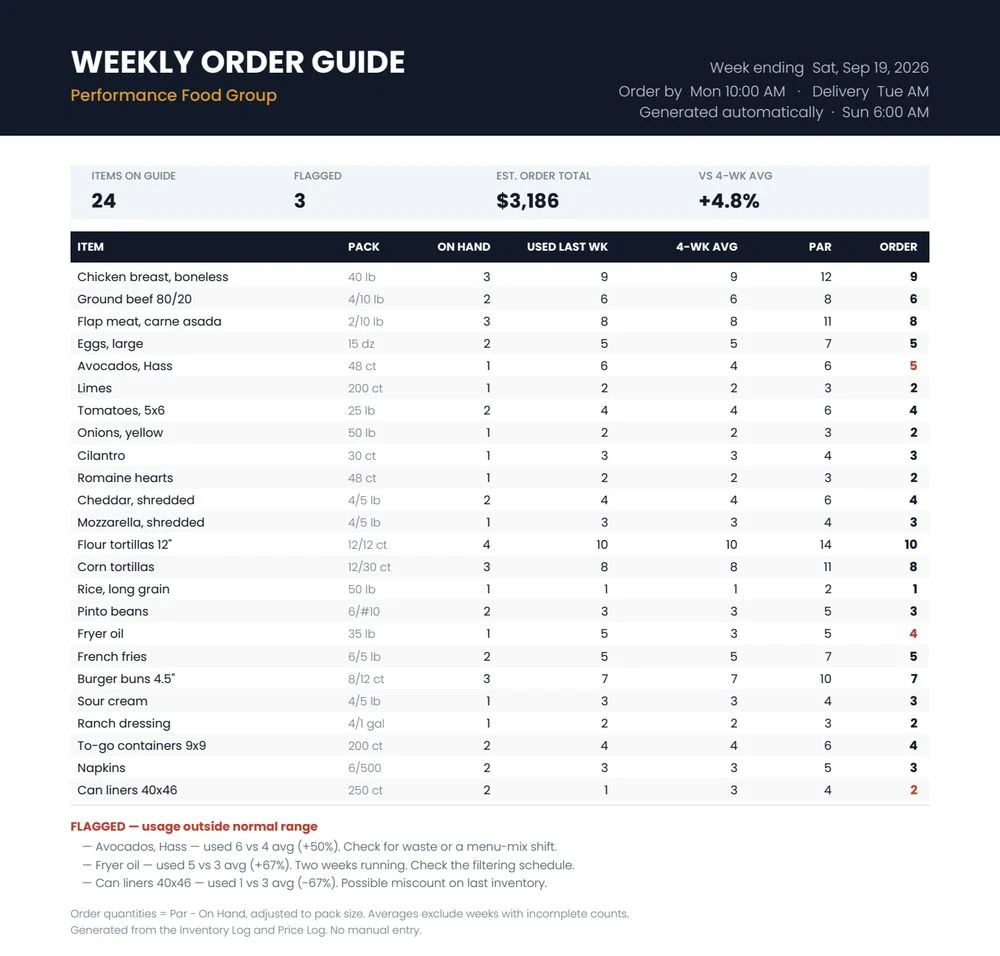
Instead of relying on someone to sit down and manually enter every invoice line by line, we could capture the invoice itself and attach the pricing information to the system.
That gave us three things we previously couldn't maintain consistently:
Inventory counts
We could record what we actually had instead of simply looking around before an order.
Purchase and vendor-price history
Invoice information could be captured and product prices logged so we could compare what suppliers were charging over time.
Usage compared with sales
Most importantly, we could compare how much product disappeared from inventory with how much product should have been used based on what we sold.
The difference was not that we suddenly cared more about inventory.
The difference was that the process became practical enough to keep using while running the restaurant.
The pepperoni discrepancy
Once we had enough inventory and sales data to compare expected usage with actual usage, one number stood out.
We were using approximately 30% more pepperoni than our expected recipe usage suggested we should be using.
We checked the numbers because the difference was too large to ignore.
The sales data told us how much pepperoni should have gone out.
The inventory data told us how much actually went out.
The purchasing data helped confirm the pattern.
The gap was real.
When we annualized the excess usage at our ingredient cost, it was one of the largest avoidable costs in the kitchen:
~30% over recipefrom one ingredient.
Without that comparison, we would have kept ordering pepperoni every week and assumed the usage was normal.
The product wasn't obviously disappearing.
There was no dramatic theft event.
There was no single day when someone suddenly wasted a large amount of food.
It was a small operational difference repeated thousands of times.
Then we started finding other problems
Pepperoni was the largest and clearest example, but it wasn't isolated.
When we looked at other meat toppings, we found some products being used at rates approximately 40–50% higher than the recipes called for.
That can happen for many reasons:
- portions gradually getting larger
- employees eyeballing ingredients
- inconsistent training
- product dropped or discarded
- prep practices changing over time
- recipes not being followed consistently
The important difference was that now we could measure it.
Instead of management saying:
"I think we're putting too much meat on these."
we had a measurable variance that could be compared week after week.
Vendor price creep was another hidden cost
The same system also exposed another problem that manual invoice tracking had made difficult to see.
Prices were changing.
Some less frequently purchased items had increased roughly 10–18% without us realizing it.
This is especially easy to miss when a product isn't purchased every week.
If an item costs $55 one month and $63 several purchases later, most managers are not going to remember the exact historical price.
And even if the old invoice still exists, someone has to go find it.
With a price history, the comparison becomes immediate.
Instead of only seeing:
Now the price change is actionable.
We can question the vendor, compare suppliers, adjust menu pricing, substitute a product, or consciously accept the increase.
The important thing is that the cost doesn't stay invisible.
The time savings mattered too
The financial discoveries were significant, but the system also changed the amount of time spent gathering information.
Before, we were repeatedly walking the restaurant, checking shelves, counting product, hunting through invoices, and trying to remember what had been ordered previously.
A large part of the process had to be repeated every delivery cycle because we weren't building a reliable historical record.
Now the information accumulates.
Instead of starting from scratch every time, we have something to compare against.
That reduces:
- repetitive counting
- time spent searching for old invoices
- manual price entry
- missed price increases
- emergency orders
- over-ordering
- running out of important products
The system didn't eliminate management judgment.
It gave management better information to use that judgment.
What we learned
The biggest lesson from this project was simple:
Inventory systems fail when maintaining the system takes more time than the restaurant can realistically give it.
We already knew inventory mattered.
We already had invoices.
We already had recipes.
We already had scales.
What we didn't have was a process that could reliably turn all of that into usable information every week without demanding hours of manual administrative work.
Once the invoice data, inventory counts, prices, sales, and expected usage could actually be compared, the hidden problems became visible.
And in our case, one ingredient alone was hiding roughly 30% excess usage.
The system we built
That experience is why I built ProfitPlus, an inventory and price-tracking app for independent restaurants.
The goal isn't to give restaurant owners another complicated piece of software to maintain.
The goal is to remove as much manual data entry as possible while still giving management the numbers that matter.
The system is designed to help track:
- invoice purchases
- vendor pricing
- price changes
- inventory counts
- ingredient usage
- expected versus actual usage
- unusual variances
- ordering information
The current price is:
30-day free trial, then $49/month per location
The goal isn't to promise every restaurant a specific savings.
Every operation is different.
The goal is to make it much easier to answer a question most independent restaurants struggle with:
Where is our food cost actually going?