Historical sales
Past daily sales established the restaurant's normal patterns by day and season.
Restaurant Sales Forecasting Case Study
Weekly schedules were easier to build after answering a harder question first: how much business should the restaurant expect on each day? Historical averages alone missed meaningful changes caused by seasonality, weather and local events.
Past daily sales established the restaurant's normal patterns by day and season.
Weather was treated as an operating input when it materially changed customer demand.
Event-driven demand was accounted for rather than being dismissed as random variance.
The sales forecast was translated into labor-hour targets used as a starting point for the weekly schedule.
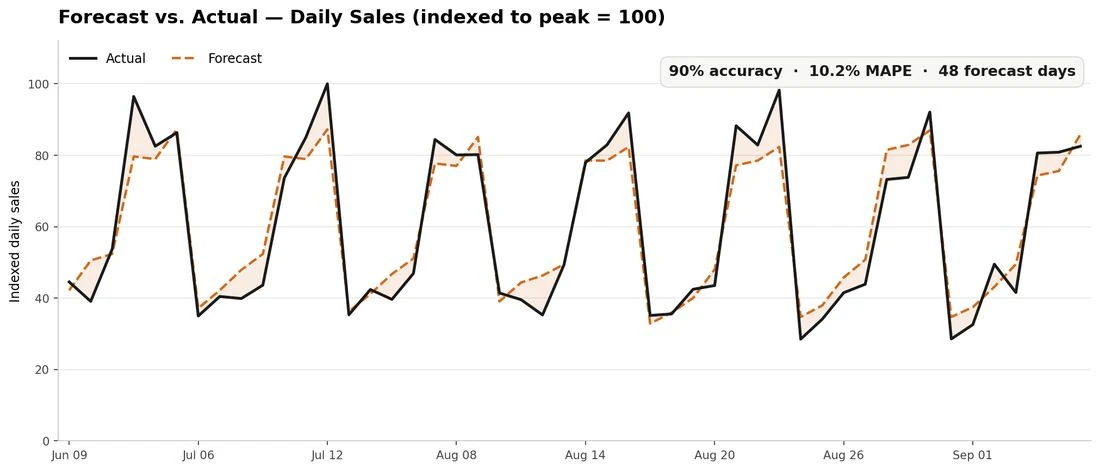
The daily sales forecasting model was validated at 90% accuracy.
The forecast then became an operating input rather than a report: expected demand was converted into labor-hour targets used while building the schedule.
Labor targets are more useful when they start from expected demand rather than a fixed percentage applied after the fact.
A forecast should be checked against actual sales so management knows how much confidence to place in it.
The value is not the forecast itself; it is better prep, purchasing and staffing decisions before the day happens.