Current ingredient cost
Use recent vendor prices so recipe and purchasing decisions are not based on stale costs.
Restaurant food cost control
Track the drivers behind restaurant food cost—vendor prices, inventory usage, recipe cost and purchasing—in one system built around the way your restaurant operates.
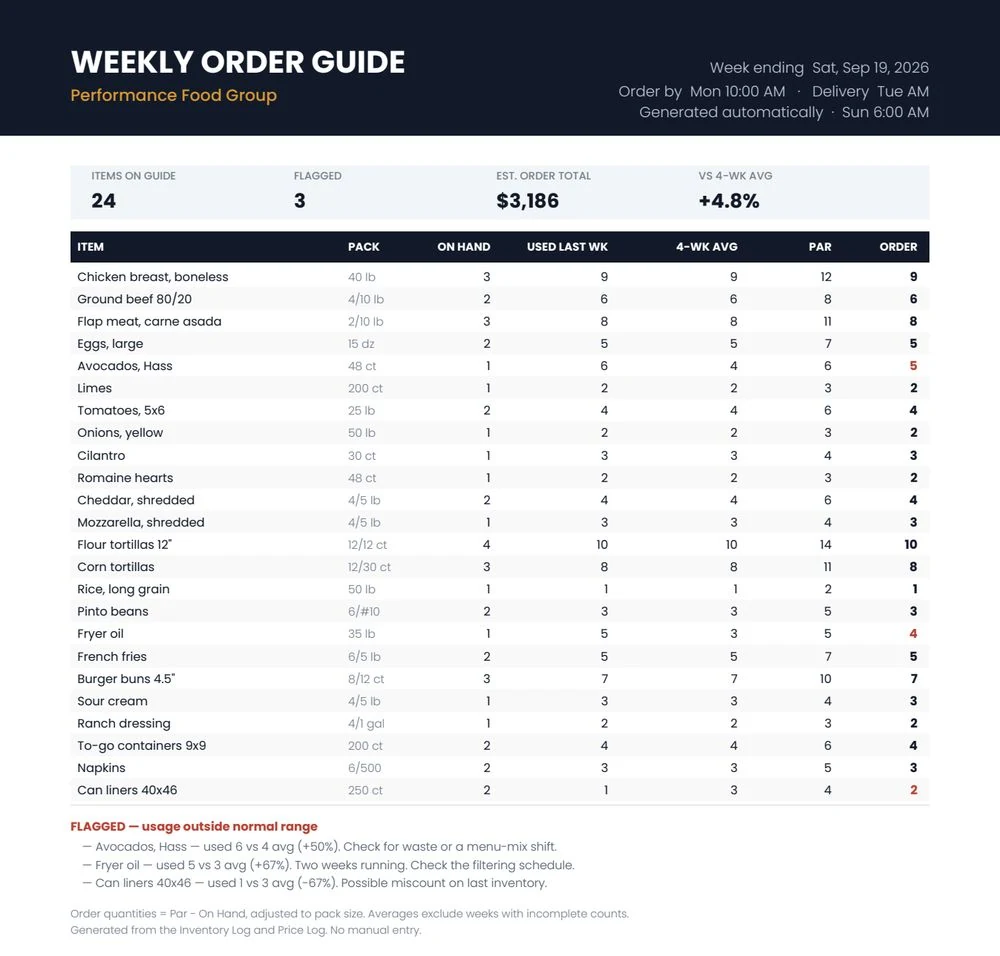
A food-cost percentage tells you something changed. The operating system should help you see whether the cause is vendor pricing, recipe cost, waste, portioning, inventory usage or purchasing.
Use recent vendor prices so recipe and purchasing decisions are not based on stale costs.
Compare expected purchasing and usage patterns with what is actually leaving inventory.
Flag supplier increases early instead of discovering them weeks later in a broad food-cost percentage.
Connect recipe cost to selling price so you can see which items have enough contribution margin.
The strongest version is not a standalone calculator. Invoice prices update the cost database, inventory reveals usage, and the same information can feed recipe costing and purchasing decisions.
Use these free tools for quick calculations, then connect the same numbers to your invoices, inventory and recipes if you want them to update automatically.
A Recipe Database, Food Cost Database and Margin Matrix connected ingredient costs to contribution margin for pricing decisions.
Start by separating the drivers: current ingredient prices, purchasing, inventory usage, waste, portions and menu pricing. A connected system makes those drivers visible rather than relying only on one monthly percentage.
Food cost percentage compares food cost with the related food sales for the period. The calculation is useful, but diagnosing the cause requires current purchasing and usage data.
Yes. Invoice data can be compared with prior purchases so meaningful price increases are flagged for review.
Yes. Recipe costing can use current ingredient prices to estimate the current food cost and contribution margin for menu items.
No. The food-cost workflow can be built around the purchasing, inventory and sales data you already have.
The fastest way to know whether a custom system makes sense is to look at the current process, where time is lost, and which numbers you need to trust.